Overview: If this katana could talk, the stories it would tell...This fantastic and extremely stout and healthy sword in handachi koshirae has seen and existed through countless battles of the past and could see countless more in its current condition. It has a rather interesting story to tell, but first the specifics.
Blade: This sword is likely a Late Muromachi sword based on its characteristics. Further inspection pointes to Sue-Seki and a specific but in general, style of suriage called Tensho-age (or Tensho-suriage, more on that later) Showing Sue-Seki workmanship in the Mino tradtition, we find Mino style Gunome Boshi, Togari-Gunome Hamon, coarse Itame and Mokume grain, Shirake-utsuri and Hadatatsu. While the polish is old, there is plenty of life left on the sword and there are no visible construction flaws. You will notice an extremely shallow sori-.98cm to be exact. This is not Kanbun-Shinto, or Kinnoto, but the result of Tensho-age and Machi-okuri of a much larger sword. The fact that the sword was not originally forged with this length in mind can be felt in its point of balance which is much more forward leaning than typical. This is a durable battlefield chopper-not an elegant status symbol or dueling piece. The Sukesada mei was most likely a Late Edo addition as was popular at the time.
Koshirae: We are excited to list another sword featuring the amazing work of Cottontail Customs (www.cottontailcustoms.com) The tsuka was completely redone and features premium samegawa in full wrap and premium Japanese nubuck with hishigami. It is solid as a rock and ready for a whole lot of sword work or to be displayed for centuries to come. Take note-The full wrap compressed the core (as was expected) so this tsuka will not pop off like a traditional tsuka. I left it up to the end user to decide if they wanted to file out the internals to adjust the fit. As it sits, you be hard pressed to find a sword as old as this more suitable for class work. The handachi fittings are all a matching traditional design in shakudo nanakoji with gold outline. The shibabiki is a tad loose and is the only known issue with the koshirae. The antique menuki appear to be brass and feature a flower motiff. The Ajiro-mon iron tsuba is signed 紀宗近作 — Ki Munechika saku and 明珍大和守 — Myōchin Yamato no Kami. While this signature is unverified, it does not scream gimei and may be worth further research.
Information of Note: Typically, most (not all) suriage swords appear with kiri nakago-jiri and multiple mekugi-ana (again, not always) So how is this sword classified as O-suriage with a finished nakago-jiri and only one mekugi-ana? Tensho-age. When Nobunaga was hitting his stride and the battle-space was rapidly changing, the tools needed to change as well. There were warriors that preferred these 80cm masterpieces but understood times were changing and needed something to match the times. Tensho-age was the act of shortening a sword-possible of extreme value to someone and making it appear as if it was originally forged that way. Instead of an abrupt cut (kiri-jiri) time was taken to taper the nakago (more taper than typical) and finish the end to create a more presentable piece. Swords had been shortened long before this, but more as a recycling or salvation measure. This was more of an ancient "mod" so to speak. So then the next question comes "Why only one mekugi-ana?" That is because almost the entirety of the nakago you see now, was original blade at one point. If you measure from the current mekugi-ana to the end of the nakgao and you made an assumption the original mekugi-ana was right there, you would be adding about 12 to 15 cm of blade...that would put this sword right at around 80-83cm. The shallow sori is a result of that previous 12-15cm of blade being "below the waist" of koshi-sori. The sword we see today is the upper portion. Fascinating!
Issues: Loose shibabiki. Extremely tight tsuka due to premium full samegawa re-wrap. Use appropriate tools for removal.
Type: Katana, Shinogi-Zukuri
Class: Shinken/Study
Period: Late Muromachi
School: Sue-Seki
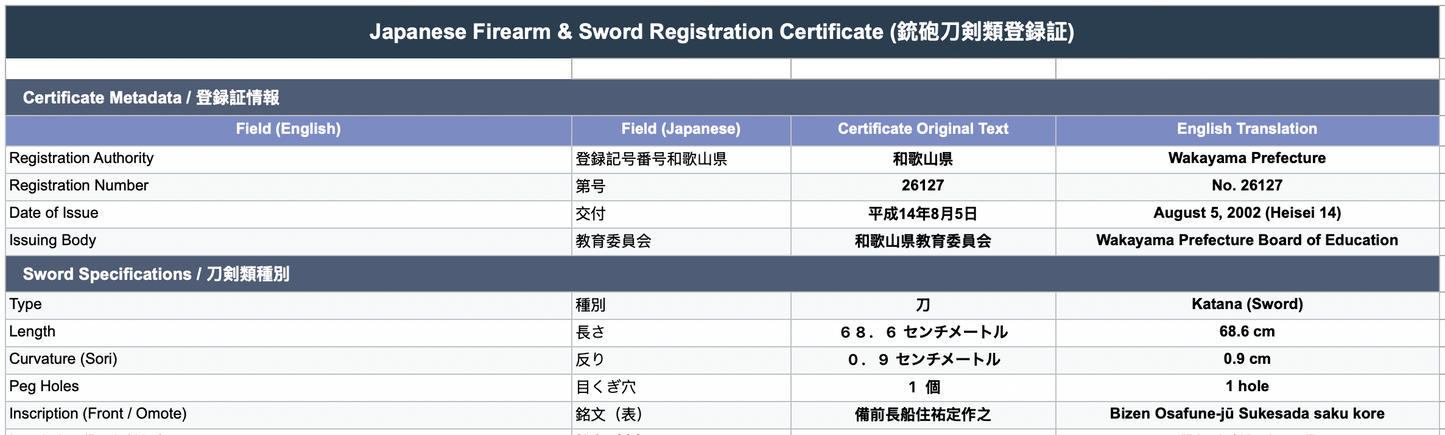
Nagasa: 69cm
Sori: .98cm
Motohaba: 31.1mm
Sakihaba: 21.1mm
Motokasane: 7.05mm
Sakikasane: 5.08mm
Weight: 760g
Nakago: O-Suriage (Tensho-age) and Machi-okuri
Mekugiana: 1
Mei: Omote-Bizen Osafune-jū Sukesada saku kore (備前長船住祐定作之) Gimei
Yasurime: Katatte-yasuri
Kissaki: Ko-Kissaki with Gunome Boshi
Hamon: Togari-Gunome
Hada: Coarse Itame with Mokume. Shirake-utsuri. Hadatatsu.
Tsuka Length: 26.5cm
Total Length: 100.3cm
Total Weight: 1318g
Registration: No. 26127 Wakayama Prefecture, 5th August, Heisei 14 (2002)
All measurements taken by hand and subject to variance. We are not responsible for errors in description or history/attribution. Please review all photos carefully and purchase with confidence.
Ashigaru Armory 2026
www.ashigaruarmory.com
www.YouTube.com/@AshigaruArmory
www.instagram.com/@ashigaruarmory